Son[i]a #469
Aram Lee

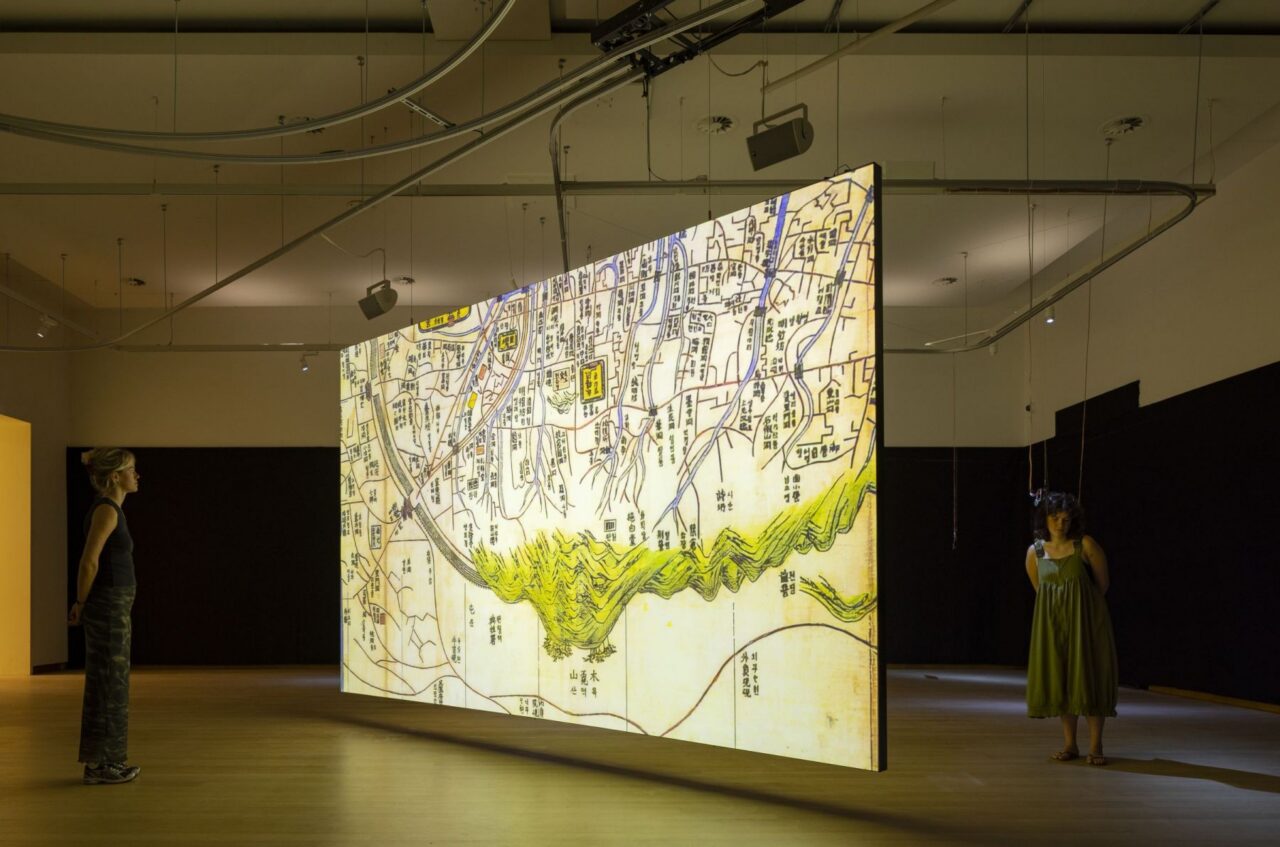
Aram Lee, "Every Worm Trampled is a Star", (2025). Installation view, Buro stedelijk, Stedelijkmuseum Amsterdam, 2026. Photo: Peter Thijhuis
Amsterdam-based Korean artist Aram Lee works across moving image, installation, performance and research, tracing how histories of occupation, colonial violence and militarisation remain embedded in objects, bodies, landscapes and ecological matter. Her practice is particularly interested in the material afterlives of these histories: externalised memories of occupied land, the persistence of toxic substances, and the ways in which institutions attempt to preserve, classify and control the remains of the past. Ethnographical museums become a particularly charged site for this inquiry, revealing paradoxes in which practices presented as preservation can also perpetuate violence.
Lee’s methodology is collaborative and deliberately porous, often treating her research as a process of mediation between different kinds of agents rather than as a solitary act of interpretation. These agents can be people (scientists, researchers, performers, historians) or marginalised and otherwise overlooked forms of matter and life: museum objects, microbes, water, soil, toxic substances, archival traces. This approach allows Lee to shift attention away from established human narratives and institutional categories, giving agency to things that have been rendered invisible, inert or peripheral.
In this podcast, we talk to Aram Lee about poisoned lands, toxic materials, restitution, and the use of artistic mediation as a way of making otherwise hidden continuities of violence, toxicity and memory perceptible.
With the support


Coproduced by:


Funded by the European Union. Views and opinions expressed are however those of the author(s) only and do not necessarily reflect those of the European Union or the European Education and Culture Executive Agency (EACEA). Neither the European Union nor EACEA can be held responsible for them.
Conversation: Roc Jiménez de Cisneros and Anna Ramos. Script, sound production and voice over: Roc Jiménez de Cisneros. Sounds: RWM sound library.
ATTRIBUTION/NON-COMMERCIAL/SHARE-ALIKE 4.0 INTERNATIONAL (CC BY-NC-SA 4.0)
related episodes
M Murphy
Murphy works with and against technoscience in the areas of environmental justice and data politics, colonialism, sexuality, reproduction and race. Their approach is interdisciplinary not only in the sense of involving various areas of knowledge, but also in enacting their dual responsibility: the almost impossible task of dismantling extractive racial capitalism, by means of re-imagining radical Black, queer, Indigenous and feminist decolonial horizons and worlds of care. In this podcast, Murphy walks us through permission-to-pollute infrastructures in and around Chemical Valley in the Great Lakes area, the largest basin of fresh surface water on the planet.
Françoise Vergès
In this podcast, Françoise Vergès unpacks the social and environmental politics of cleaning and waste, charting and questioning temporal and spatial interactions that create a neutral site of deprivation, exhaustion and exploitation. She sheds light on the economy and politics of exhaustion, pointing out the role of racial capitalism in the climate crisis. Vergès suggests a political re-reading and understanding of vital needs and natural elements through notions of cleaning, hygiene and medicine, and raises revolutionary questions about the prefabricated assumptions of justice and social transformation through re-thinking the museum.
Fernando Domínguez Rubio
In this podcast, we talk to sociologist Fernando Domínguez Rubio about the ecologies of care that fuel the fiction of artistic stability —a network of infrastructures, climate technologies, conservation laboratories and underground storage facilities, as well as the largely invisible workers whose labour is usually left out of the traditional narrative of art, even though it is pivotal. We talk about the constant struggle against entropy, reflecting on the physical and human resources devoted to it, but also on the ethical, political, and economic implications of trying to slow down the passage of time. Because the way Domínguez Rubio sees it, the museum is much more than a space for contemplation and a collective archive: it is a political and cultural technology aimed at freezing time, ordering the world, and determining what is worthy of conservation. We talk to Fernando Domínguez Rubio about regimes of objecthood, about storage facilities, memory, and greenhouses, about uniqueness, and about other ways of holding onto things.