Son[i]a #466
blanca arias

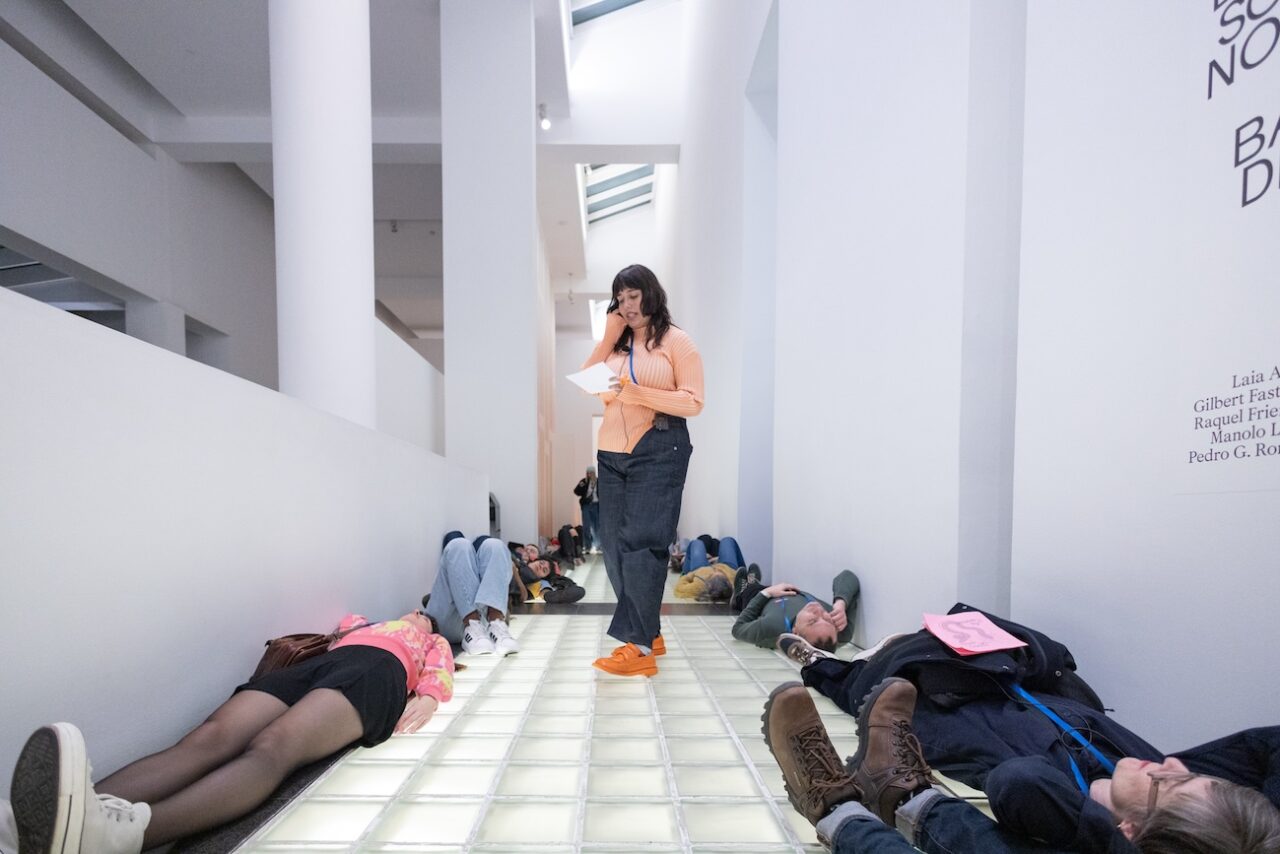
Photo: Dani Cantó.
blanca arias is an artist and a researcher, curator, educator, mediator and archivist: interconnected, permeable aspects of a practice that springs from emotion and doing-with-others as gentler means of engaging with art and images. In her first book, Blandito blandito ¿Qué le hacemos les feministas al arte?, softness emerges as a primordial materiality through which to interact with the world; an accommodative form of knowledge capable of both shaping and being shaped. In pages steeped in a desire for genealogy, bodies, readings, guts, and organs come together and converse, celebrating artists and ways of doing that have often been left out of art history narratives. The book invites us to stop thinking of artworks solely in terms of representation, to attend to their presence and to what the material itself transmits and activates.
In this podcast, blanca arias draws on numerous friends and references to discuss guts, lungs, mishearings, and her fondness for pink. We talk about historical justice and the lack of feminist critical theory literature on the image, and we ask ourselves what it might mean to ‘tenderise’ an institution. We talk about proprioception, the inclination towards the other, and the material conditions that determine how far a body, a practice, or a book can go. From ekphrasis to listening, we touch on the senses and the politics of space, pausing before we interpret, lingering with things a little longer, and pondering the nature of what is before us.
Conversation: Albert Tarrats and Anna Ramos. Script and sound production: Albert Tarrats. Voice over: Isaac Sanjuan. Sounds: RWM sound library.
ATTRIBUTION/NON-COMMERCIAL/SHARE-ALIKE 4.0 INTERNATIONAL (CC BY-NC-SA 4.0)
related episodes
Teresa Rubio
In this podcast, cultural mediator, educator, and collage artist Teresa Rubio fills us in on her way of understanding (and putting into practice) the third space that emerges in mediation. Much more than simply providing a few sofas, mediation entails being among and with others, which also opens up “other ways” of occupying and inhabiting the museum. For Teresa, mediation inherently contains performance, listening, and reproductive care work. Moreover, it is as much about individual authorship as it is about collective writing. And in order to realise its full potential, it often needs to be an internal process too.
Itxaso Corral
The work of artist Itxaso Corral calls on an extensive glossary of concepts, media, and practices that explore beyond the bounds of closed definitions, in a gesture that simultaneously expands the scope of possibility of so-called live arts. In this podcast, Itxaso Corral shares with us the small rituals that give shape and meaning to her artistic activities: pulsations of life that emerge through performance, dance, singing, and calligraphy as experiential spaces, which are the result of lived experience and long durations, and of the energy that arises from learning and doing with others.